

What local business marketing is
Local business marketing is everything you do to attract and keep customers in your area. It’s narrower than “marketing” in a useful way. You don’t need the whole internet. You need the people within driving distance who need what you sell this week, and the people who already bought from you once.
Unlike national marketing, it’s built around proximity and trust. People prefer a nearby business they believe is reliable, so local signals, reviews and reputation matter more than raw reach. Win your local market and you don’t have to win anything else.
It comes down to three jobs, and most local businesses are strong at one and leaking at the other two.
The rest of this guide takes each piece in the order it usually pays back, then shows how to run them as one system on whatever budget you have.
The local advantage
A local business has things a national chain can’t fake: a real address, an owner people can meet, reviews from neighbors and knowledge of the area. Google’s local results are built to reward relevant, nearby, well-reviewed businesses, which is exactly what a good local business already is.
That’s why a focused local business can outrank a much bigger competitor for “near me” and city searches. You don’t need the biggest budget. You need to win the handful of searches and signals that matter in your area, and keep winning them.
Local is a game a small business can actually win, as long as it plays it every month.
Your Google Business Profile
For most local businesses, the Google Business Profile is the most-seen piece of marketing they own. It powers the map pack, it often gets more views than the website, and customers can call, get directions or book from it without ever visiting your site.
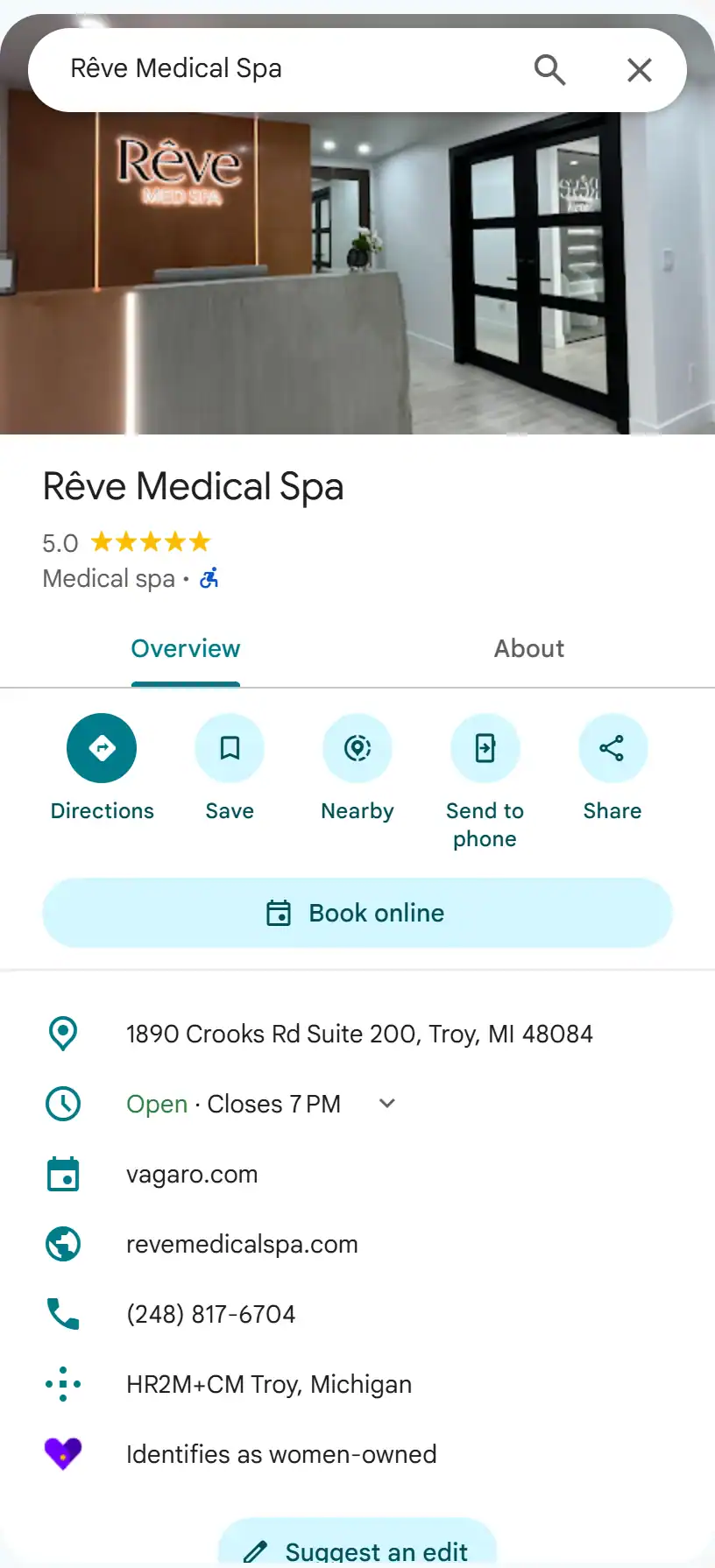
Pick the most specific primary category, fill every field, add real photos, post updates and connect booking if you take appointments. Most local businesses leave the profile half finished, which is exactly the opening for you. The full walkthrough is in the Google Business Profile guide.
Local SEO
Local SEO gets you into the map pack and the “near me” results through your profile, consistent listings, reviews and genuinely local pages on your website. It’s the durable engine of local discovery: visibility you don’t pay for per click, and it builds on itself over time.
If you serve more than one town, a real page for each city you serve lets you rank across the whole area instead of only your home base. “Real” is the important word. Pages that only swap the city name get filtered. Pages that mention the roads, neighborhoods and details a local customer recognizes rank and convert.
Keep your business name, address and phone identical everywhere they’re listed: Apple Maps, Bing, Yelp, Facebook, your chamber and your industry’s directories. Mismatches left over from a move or a rebrand quietly hold rankings back. The step by step is in the local SEO guide.
Reviews and reputation
Reviews are the heart of local marketing. They’re a major local ranking factor and the biggest reason a customer picks you over the business next door. No other tactic returns as much for as little money.
Ask at the right moment
Ask every happy customer on the day the job goes well, with a direct link to your Google review form. A short, personal text works better than a generic email: “Thanks for having us out, Dave. If you have a minute, a quick Google review helps other people in Birmingham find us.” Make it part of how every job ends, not something you remember twice a year.
Answer every one
Thank people for the good reviews in a sentence that mentions the actual job. Answer the bad ones calmly and specifically, and take the conversation offline. The next customer reads your reply more closely than the complaint.
Never shortcut it
Don’t buy reviews, don’t write your own and don’t offer discounts in exchange for them. It breaks Google’s rules, and a steady stream of genuine reviews beats anything fake over time.
A website that turns local interest into calls
Your profile, search and ads bring people to your site, and the site decides whether they call. A fast, credible site built for phones, with a clear next step, real reviews and easy contact, turns local interest into booked jobs. A dated or slow one sends the customers you paid to attract straight to a competitor.

Check your own site on your phone, on cellular, the way a customer standing in their kitchen would. Can you tell what the business does and where in the first screen? Is the phone number one tap away? Does the quote form actually arrive in an inbox someone checks? Those three questions catch most of the leaks. More in the website design guide.
Local ads
When you need leads faster than SEO can build them, local ads deliver.
- Google Search ads catch people actively searching for what you sell, often ready to call today.
- Local Services Ads sit at the very top of results for many trades and professional services, and charge per lead rather than per click.
- Meta ads build local awareness with photos and video of your work, and suit visual, seasonal or repeat services.
Three rules keep the budget from leaking: target only the area you really serve, send clicks to a page built for that service, and track cost per lead from day one. Ads pair well with local SEO: ads for leads now, SEO for the free, lasting flow. See the Google Ads guide.
Social media and community
For a local business, social media’s real value is trust and familiarity. When someone checks you out after seeing your truck or hearing your name, they look at your page. A page with recent, genuine posts of your work and your team reassures them. An abandoned one raises questions.
You don’t need to chase viral posts. Pick one or two platforms your customers actually use and post consistently: a finished job, a behind-the-scenes photo, a seasonal reminder, a local event you’re part of.
Pair it with a real presence in the community. Sponsor a youth team, join the chamber, show up at the events your customers go to, and partner with complementary businesses (a painter and a flooring installer, a salon and a photographer). Those relationships bring referrals, and many come with a link from their website to yours, which helps local SEO too.
Referrals and repeat business
The cheapest customer is one you already have. Local businesses live on referrals and repeat business, yet most do nothing systematic to encourage either.
Stay in touch
Keep a simple list of past customers and reach out a few times a year with something useful: a maintenance reminder, a seasonal offer, a heads-up about availability. Service businesses have natural timing built in, like a furnace tune-up every fall or a touch-up appointment every year.
Make referring easy
Tell happy customers you’d love a referral, give them something easy to pass along and thank everyone who sends someone, whether or not the job closes. A customer who refers two others is worth far more than the original sale.
Deliver something worth talking about
Referrals follow experiences, not asks. Show up when you said, clean up after yourself, explain what you did and follow up afterward. Those are the details people repeat to their neighbors.
AI and local search
More people now ask ChatGPT, Gemini and Google’s AI Overviews for nearby recommendations. The answers lean on the same foundation that wins local SEO: a complete profile, consistent business details, strong reviews and clear pages that say what you do and where.
Doing local marketing well already puts you most of the way there. Ask the assistants yourself for your service in your city and note who they name. If it isn’t you, see AI visibility.
Tracking what works
Local marketing should be measured in calls, form fills and customers, not likes and impressions. Track which channels produce real leads and what each lead costs. Without that, you end up cutting the thing that works and keeping the thing that doesn’t.

At minimum: count form submissions as conversions, put call tracking on the numbers in your ads and profile, and ask every new customer how they found you. Then look at it monthly. Businesses that measure consistently move money toward what works and pull ahead of the ones that guess. The whole list is on the pre-launch checklist.
A 20-minute monthly review
Once a month, answer five questions and write the answers down so you can compare month to month:
- How many calls, forms and bookings came in, and from where?
- What did each paid channel cost per lead, and per customer?
- How many new reviews came in, and did every one get a reply?
- Which pages on the site brought in leads, and which got visits with no leads?
- What will we do more of next month, and what will we stop?
That last question is the one that matters. A report that doesn’t change what you do next month isn’t worth the time it took to read.
Running it as one system
The biggest local marketing mistake is treating these as separate tactics bought from separate people. They multiply when they’re connected: the profile and local SEO get you found, reviews and the website get you chosen, ads speed things up, referrals compound, and tracking shows which parts are pulling their weight.
A simple order that works for most local businesses:
- Fix the website’s obvious leaks and set up tracking
- Complete the Google profile and start the review habit
- Clean up listings and build pages for the cities you serve
- Add ads for speed once the page converts and tracking works
- Layer in social, community and referrals to compound it
That’s the idea behind our Foundation package: the website, local SEO, ads and AI visibility built as one system you own.
Local business marketing on a tight budget
Some of the most effective local marketing costs little more than consistency.
Nearly free, and high return
- Complete the Google Business Profile and keep it active
- Ask every happy customer for a review
- Keep your name, address and phone identical everywhere
- Post real photos and updates regularly
- Join the chamber or one local group, and show up
Where to spend first
As budget allows, put money into a website that converts first, so the free traffic you earn turns into customers. Then add local SEO work, then ads to accelerate. A business that nails the free fundamentals often out-markets a competitor who spends more and neglects them.
Where to focus, by type of business
The pieces are the same for everyone, but the weight shifts with how your customers buy.
Urgent and emergency services
Plumbers, locksmiths, towing, restoration, HVAC in January. The customer needs someone now and calls one of the first businesses they see. The map pack, Local Services Ads where your trade qualifies, and a phone that gets answered live matter more than anything else. A missed call is usually a lost job, because they’ll just call the next listing.
Planned, higher-ticket projects
Remodelers, roofers, custom glass, landscaping. The customer compares two or three businesses over days or weeks. Reviews, photos of finished work, clear pages for each service and a quote process that feels easy decide it. Follow-up matters here: the business that checks back politely after the estimate often wins.
Appointment-based services
Med spas, salons, permanent makeup, dental, fitness. Online booking, before and after photos where appropriate, a strong review count and staying in touch between visits carry the most weight. Repeat and referral business is a large share of revenue, so retention deserves as much attention as new customers.
Storefronts and restaurants
Accurate hours, great photos, a menu or product details on the profile, and reviews come first. Social media and community events do more work here than for most service businesses, because people choose places they’ve seen and heard about.
A 90-day plan to get started
If you’re starting from a neglected foundation, this order gets the most movement in the first three months without trying to do everything at once.
Days 1 to 30: fix the foundation
- Complete and verify the Google Business Profile, with the right primary category and real photos
- Check the website on a phone and fix the obvious leaks: phone number, next step, broken forms
- Set up form tracking and call tracking so you can count leads from here on
- Start asking every happy customer for a review
Days 31 to 60: get found in more places
- Clean up your listings on the major directories so every detail matches
- Build or rewrite pages for your top services and the cities closest to you
- Post on the profile weekly and on one social platform your customers use
- If you need leads quickly, launch tightly targeted search ads to your best service page
Days 61 to 90: compound what works
- Look at leads by source and move effort toward the channels that produced customers
- Add pages for the next ring of cities you serve
- Send a useful note to past customers and ask for referrals
- Join one local group or sponsor one local event, and follow through
By the end of the quarter you’ll have a working profile, a site that converts, a review habit and three months of real numbers to plan the next quarter from.
If you hire someone to help
Plenty of owners do this themselves, and plenty hand it off. If you hire help, ask a few questions first:
- Will every account (profile, website, ads, analytics) be in my name, so I keep them if we part ways?
- Do you report in calls, leads and cost per lead, or only in rankings and traffic?
- What will you do in the first 30 days, specifically?
- Will you tell me when something isn’t worth doing?
Be wary of long contracts, guaranteed rankings and anyone who wants to run ads before checking whether the website converts. Those are the most common ways local businesses spend money and end up with nothing they own.
Common local marketing mistakes
- A half-finished or neglected Google Business Profile
- Not asking for reviews, the biggest lever left idle
- A slow, dated website that loses the customers you attract
- Different names, addresses or phone numbers across listings
- No pages for the cities you actually serve
- Running ads before tracking works
- Treating each channel separately instead of as one system
- Ignoring past customers, referrals and repeat business
The local business marketing checklist
- Complete your Google Business Profile and keep it active
- Make your name, address and phone identical everywhere
- Ask every happy customer for a review, and answer every review
- Make the website fast on a phone, with one clear next step
- Test every form and confirm it arrives
- Build a real page for each service and city you serve
- Track calls and forms by source
- Run tightly targeted ads only once tracking works
- Post real work on one or two social channels
- Show up in your community and build partnerships
- Stay in touch with past customers
- Make referrals easy, and thank the people who send them

